
Melanoma
This section provides statistics relating to melanoma cancer registrations and deaths in Aotearoa New Zealand.
Melanoma is a serious form of skin cancer, and New Zealand has some of the highest rates in the world [1].
Please note that custom mortality data releases from Health NZ - Te Whatu Ora only become available once the data on external causes of death is sufficiently complete. EHINZ has just received data for 2021 and will publish updated surveillance on melanoma mortality shortly. For more information on the Mortality Data Collection, visit the Te Whatu Ora website.
 Surveillance Reports and Metadata


On this page:

Melanoma and environmental health
Melanoma is a serious form of skin cancer, and, together with Australia, New Zealand has the highest rates in the world [1]. In 2023, there were 3,401 registrations of melanoma in New Zealand.
Overexposure to UV radiation from the sun is the main environmental risk factor for melanoma. It has been estimated that more than 90% of all melanoma cases in New Zealand can be attributed to UV radiation exposure [2].
Other risk factors for melanoma include:
-
fair skin, and skin types that burn or freckle easily
-
a history of heavy sun exposure and sunburn, including sunbed and sunlamp use
-
family history of melanoma.
There were 3,401 melanoma registrations in 2023
In 2023, there were 3,401 melanoma registrations in New Zealand. The melanoma registration rate has consistently been higher for males than females over the past 20 years. Melanoma was the third most commonly registered cancer in 2020 for males (behind prostate cancer and colorectal cancer) and for females (behind breast and colorectal cancer) [3].
For more information on melanoma registrations, view the surveillance report at the top of this page.
333 people died from melanoma in 2021
In 2021, there were 333 deaths from melanoma in New Zealand, this is still an 11.9% decrease since the previous peak in 2015 (378 deaths).
The age-standardised melanoma mortality rate was 3.5 deaths per 100,000 in 2021, well under the 2011 peak (5.3 per 100,000) (Figure 1). The decrease between 2015 and 2018 coincided with the introduction of two new treatments for advanced melanoma - Opdivo and Keytruda [4]. In 2020, the lower number of melanoma deaths might be due to the COVID-19 pandemic, during which healthcare systems worldwide faced disruptions from national lockdowns and restricted services that may have delayed access to care.
Melanoma mortality increases with age and is higher for males than females. In 2021, rates were at least twice as high for males aged 65+ years compared to females in the same age group.
Age-standardised melanoma mortality rates for 2012–21 were highest in the European/Other ethnic group (5.0 per 100,000), almost five times the rate for the next most affected group, Māori (1.1 per 100,000).
Figure 1: Melanoma mortality, all ages, 2001–2021 (age-standardised rate per 100,000)
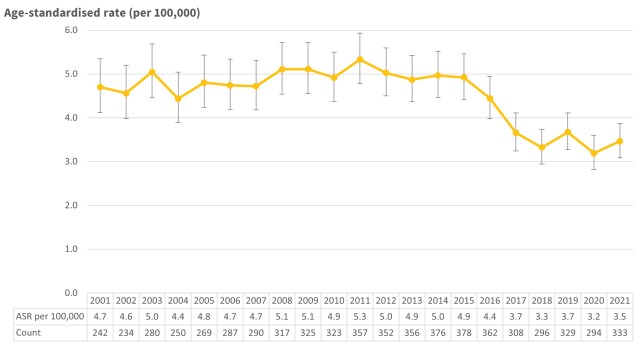
Note: 95% confidence intervals have been presented as vertical bars.
Source: New Zealand Mortality Collection
Information about the data
Melanoma cancer registrations and deaths
Source: New Zealand Cancer Registry (latest available data is for 2023), New Zealand Mortality Collection (latest available data is for 2021).
Definition: Melanoma is defined as melanoma of the skin registrations (ICD-10 C43) in the New Zealand Cancer Registry. Rates are per 100,000 people, and have been age-standardised to the WHO world standard population.
References 
1. Wild CP, Weiderpass E, Stewart BW, editors. 2020. World Cancer Report: Cancer Research for Cancer Prevention. Lyon, France: International Agency for Research on Cancer. Retrieved 4 November 2022 from: http://publications.iarc.fr/586.
2. Arnold M, de Vries E, Whiteman D, Jemal A, Bray F, Maxwell Parlin D, Soerjomataram I. 2018. Global burden of cutaneous melanoma attributable to ultraviolet radiation in 2012. International Journal of Cancer. 2018 Apr 16;143:1305-1314.https://doi.org/10.1002/ijc.31527.
3. Te Whatu Ora. 2020. Cancer web tool: Number of common cancer registrations and deaths by sex. Accessed 14 December 2023 from: https://tewhatuora.shinyapps.io/cancer-web-tool.
4. Mason K, Kelly L, Jackson C, Read D, Borman B. 2022. Did new treatments contribute to a decrease in melanoma deaths? New Zealand Medical Journal: 135 (1558), 90-95. URL: https://journal.nzma.org.nz/journal-articles/did-newtreatments-contribute-to-a-decrease-in-melanoma-deaths.
 Useful links
 Downloads
 Useful links
 Back to Top