
Meningococcal disease
 Surveillance Reports and Metadata


Household crowding and second-hand smoke exposure increase the risk of meningococcal disease
Meningococcal disease is a serious infection which can cause meningitis (an infection of membranes that covers the brain), septicaemia (blood poisoning), and even death. Household crowding increases the risk of meningococcal disease, particularly in those aged 0–16 years [1]. Second-hand smoke exposure is also associated with an increased risk of meningococcal disease in children [2,3].
Meningococcal disease notifications continue to decline in 2024
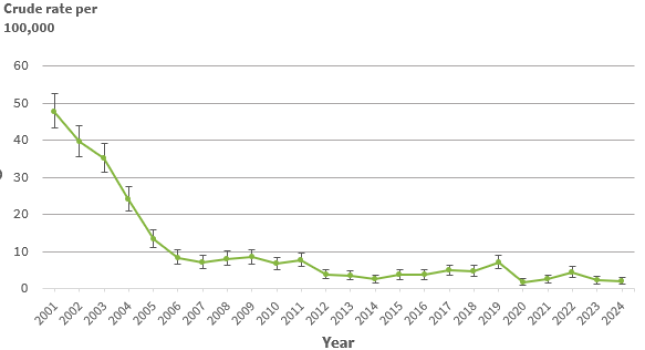
The number of meningococcal disease notifications among children aged 0–14 years continues to decline from 42 (4.4 per 100,000; 95%CI 3.1–5.9) in 2022 to 21 (2.2 per 100,000; 95%CI 1.3–3.3) in 2023 and 18 (1.8 per 100,000; 95%CI 1.1–2.9) in 2024 (Figure 1). This decrease has been driven by a drop in the number of notifications among children under five years old
Figure 1: Number of meningococcal disease notifications in children aged 0–14 years, 2001–2024
Information about this data
Meningococcal disease notifications
Source: EpiSurv notifications surveillance database, Public Health and Forensic Science (PHF Science – formerly ESR).
Definition: Notifications of meningococcal disease in children aged 0–14 years. Notifications only cover those people who visited a GP or received hospital treatment, and therefore may underestimate the true rate of disease in the population.
References 
- Baker MG, McDonald A, Zhang J, et al. 2013. Infectious diseases attributable to household crowding in New Zealand: A systematic review and burden of disease estimate. Wellington: He Kainga Oranga/ Housing and Health Research Programme, University of Otago.
- Murray RL, Britton J, Leonardi-Bee J. 2012. Second-hand smoke exposure and the risk of invasive meningococcal disease in children: systematic review and meta-analysis. BMC Public Health 12:1062.
- Lee CC, Middaugh N, Howie SRC, et al. 2010. Association of second hand smoke exposure with pediatric invasive bacterial disease and bacterial carriage: a systematic review and meta-analysis. PLoS Medicine 7(12): e1000374. doi:10.1371/journal.pmed.100037
 Useful links
  Downloads
 Useful links
 Back to Top